You risked 1% per trade. So how did the account blow up?
Same strategy, same signals. At 1% risk per trade our test account was wiped out. At 0.25% the fall was a quarter as deep. Size decides.
TradeXAI research · 5 min read
"Never risk more than 1% per trade." It is the first rule in every trading book, and it is a good one.
It is also incomplete. We ran a breakout strategy that followed it exactly, and the account would have been gone.
Most backtest reports show the return. Few say how large each position was. But size is the one setting that can turn a decent strategy into a wiped-out account.
Size from the stop, not from a feeling
The standard method has three steps:
- Decide how much of the account you accept to lose if the stop is hit. Say 1%.
- Measure the distance from the entry to the stop.
- Quantity = money at risk / distance to the stop.
A worked example. You have a $1,000 account and risk 1%, so you may lose $10.
You enter at $100 with a stop at $97. That is $3 per coin, so you buy 3.33 coins, worth about $333. Comfortable.
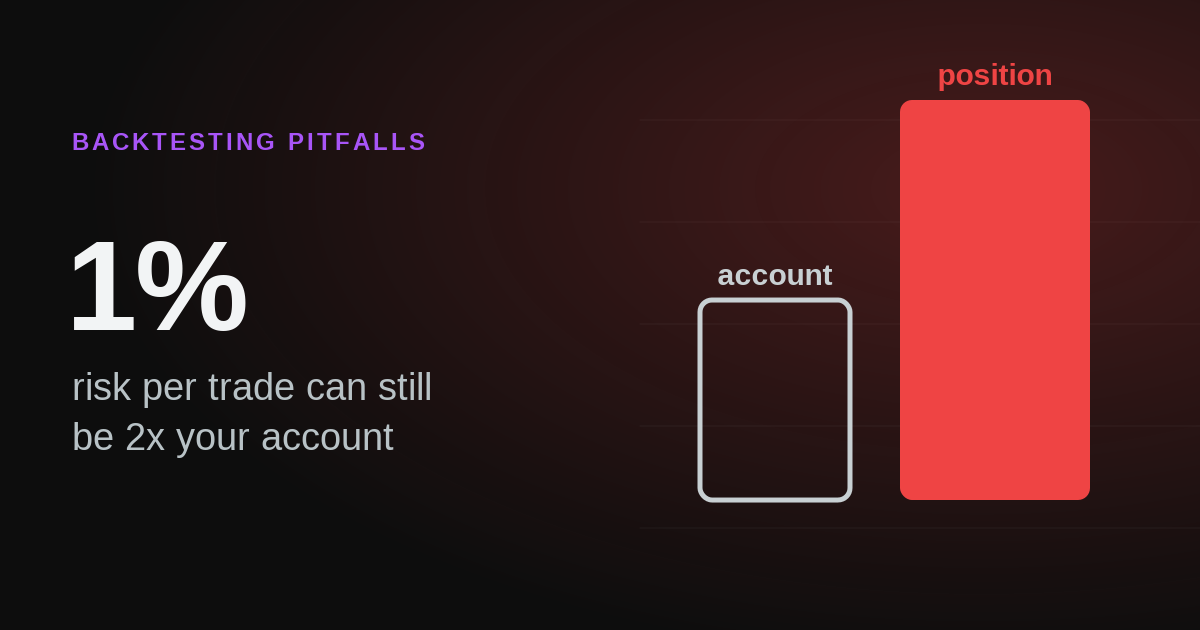
Now make the stop tighter: $99.50 instead. The same $10 of risk buys 20 coins, worth $2,000. Twice your account.
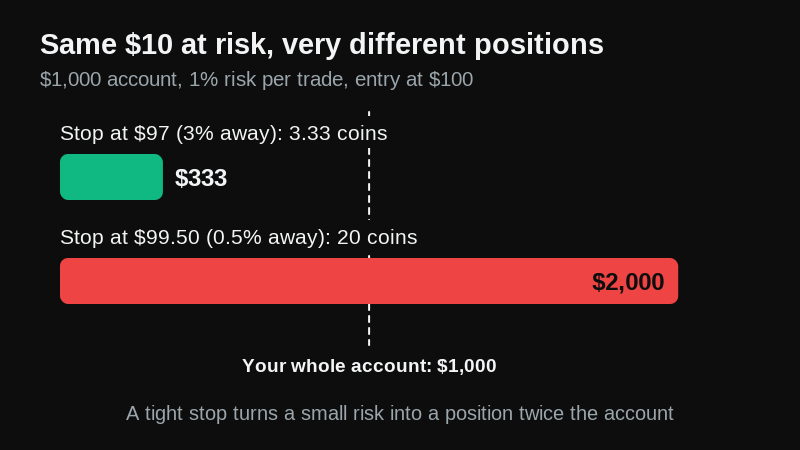
Nothing in the formula warned you. But a fast move straight through that tight stop now costs far more than 1%, because a stop is not a guaranteed price.
A tight stop turns a small risk into a large position.
The public paper bots on this site use exactly these numbers: $1,000 to start, 1% risk per trade, at most 5 trades at once, and a position is never larger than 5 times the balance.
1% per trade is not 1% of total risk
Here is how the account in the title died.
Risk adds up when several trades are open at once and they all move together. Crypto coins usually do.
In one breakout study we risked 1% on every signal. The positions together averaged 1.1 to 1.7 times the account and peaked at 5 to 6 times.
The drawdowns, measured against the starting balance, were -131% to -207%. (A drawdown is the fall from a peak.) In plain words: the account would have been gone.
At 0.25% per trade the same signals have a quarter of the drawdown. Same strategy, different life.
Leverage changes the scale, not the quality
A common hope: "my strategy is fine, I just need more leverage."
We ran our many-coin bot at 1x, 1.25x and 1.5x total exposure.
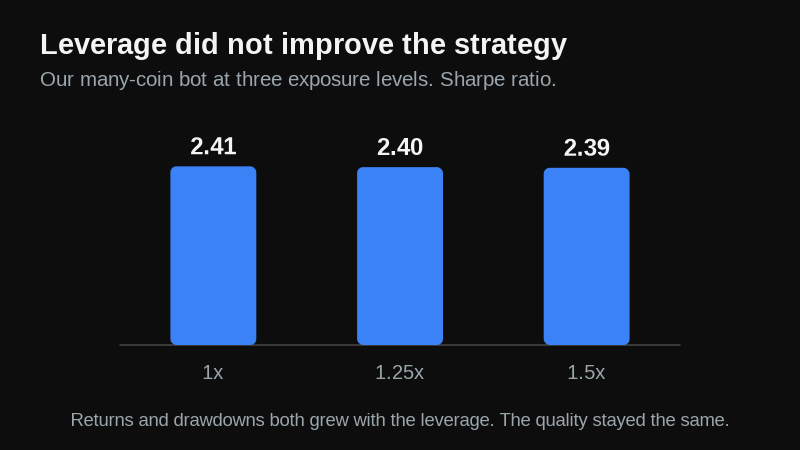
Its Sharpe stayed the same: 2.41, 2.40, 2.39. The returns grew with the leverage, and so did the drawdowns.
Leverage cannot make a strategy better. It makes the same result bigger in both directions, and it brings the liquidation price closer.
Smaller when the market is wild
One sizing rule did hold up in our tests: take smaller positions when volatility is high.
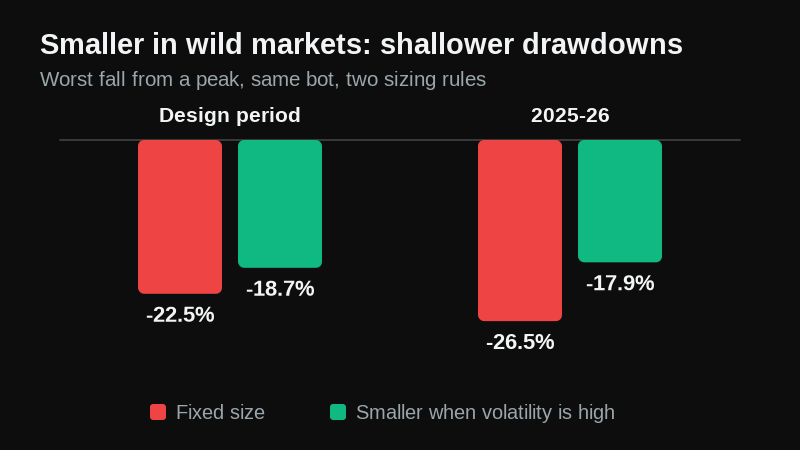
| Sharpe | Worst drawdown | |
|---|---|---|
| Fixed size, design period | 2.18 | -22.5% |
| Smaller in volatile markets | 2.31 | -18.7% |
| Fixed size, 2025-26 | 1.52 | -26.5% |
| Smaller in volatile markets | 1.70 | -17.9% |
It also earned less per month in 2025-26: 3.3% against 4.9%. That is the honest trade. A smoother ride for a lower return, not extra profit.
What did not help: switching the strategy off after a losing streak. In our tests an on/off rule based on recent results lowered the Sharpe every time.
Small accounts
Exchanges have a minimum order size per coin. With a small account, the size your rule asks for can be below that minimum.
Then you either skip the trade or take more risk than planned. Our live bot rounds up only when the minimum is at most 3 times the planned size, and skips otherwise.
Four questions before every trade
- What do I lose if this stop is hit, in dollars?
- What do I lose if all open stops are hit together?
- Is the position larger than my account? Why?
- Could I take ten losses in a row at this size?
This article is for education. It is not financial advice.
- position sizing
- risk
- leverage
- drawdown
For education only. Backtests and paper results do not predict future results. Not financial advice.