The 0.12% that decides whether your strategy works
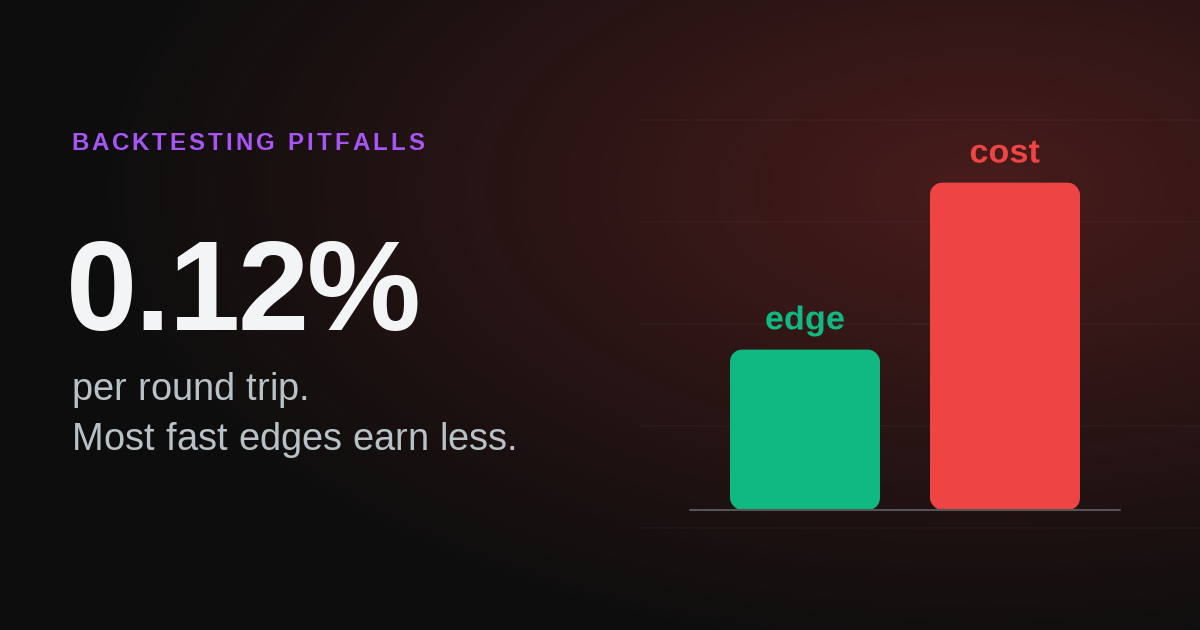
Your scalp wins a little on most trades. The exchange takes 0.12% on every one. We tested hundreds of fast strategies. Guess who won.
TradeXAI research · 5 min read
A fee of 0.05% sounds like nothing. You would not bend down to pick it up.
Then you run a strategy that trades twenty times a day, and at the end of the month the account is smaller, even though most trades were "right".
Every strategy has two results: before costs and after costs. On short timeframes the gap between them is usually bigger than the edge.
What one trade really costs
On Binance futures a regular user pays about 0.05% per fill as a taker (a market order) and 0.02% as a maker (a limit order that waits in the book).
You pay on the way in and again on the way out. In our research we also add 0.01% of slippage per fill, because a market order rarely fills at the exact price you saw.
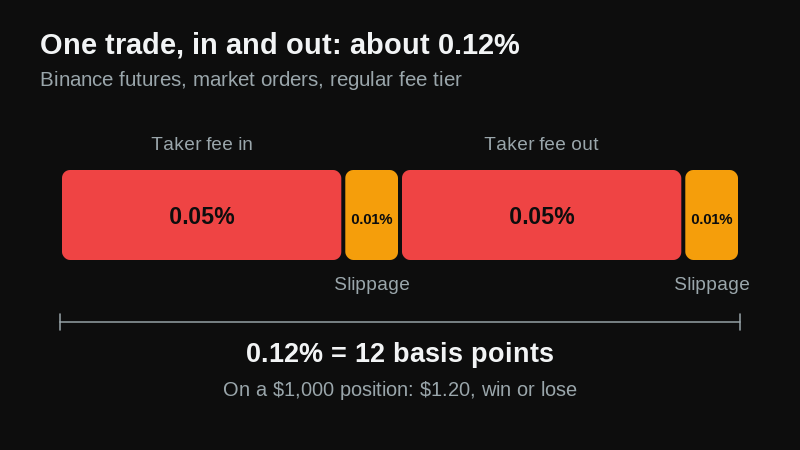
So before your idea has done anything, each trade starts 0.12% behind.
What fast signals earn
Now compare that with what fast signals earn before costs. All of these are from our own tests:
- 1-minute signals on BTC, ETH and BNB (lead-lag, pair spreads, order flow). Among settings trading at least 3 times a day, the best edge before costs was 4.9 bp per trade. The cost in that test was 10 bp.
- Limit-order scalping for a tiny target. 432 settings replayed on real trade-by-trade data. None was profitable. The best one lost 4.6 bp per trade.
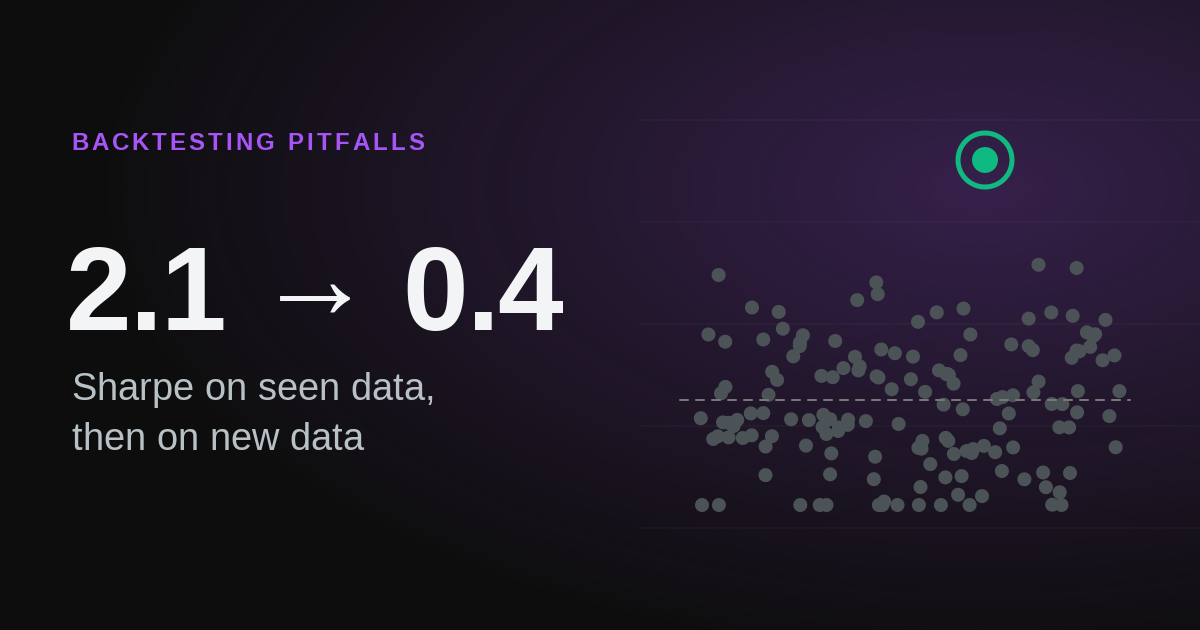
- 1-hour reversal, momentum and time-of-day rules across many coins. Sharpe before costs up to 2.2. After costs: far below zero. (Sharpe is return per unit of risk.)
- 15-minute setups such as RSI(2), Bollinger fades, EMA pullbacks and breakouts: no setup positive after costs. The median lost 7.3 bp per trade.
- One day of tick data, 126 settings, 2,267 trades: 0 positive.
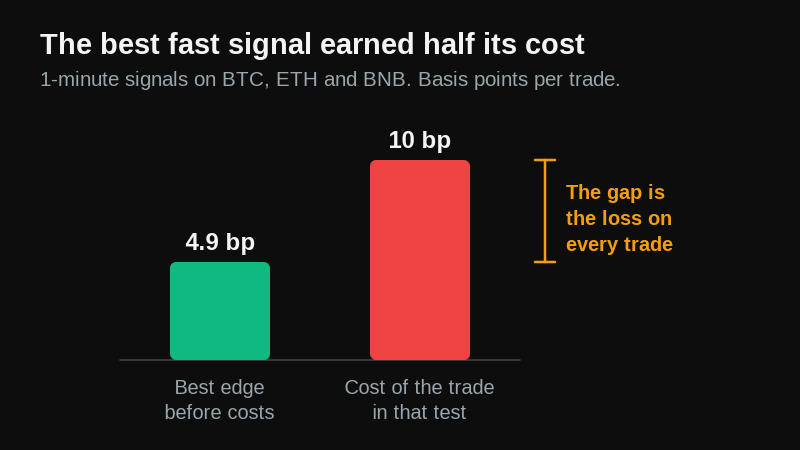
The note we wrote in our log at the time:
Without a real directional edge of more than about 5 bp per trade, a take-profit and stop bracket earns roughly nothing before costs, and the fee is the result.
Trading more often did not help our slower bot either. Rebalancing it every 1 or 2 hours instead of every 4 traded more and never scored better.
Funding: the cost your chart does not show
Perpetual futures have no expiry date. To keep their price close to the spot price, longs and shorts pay each other a funding fee, usually every 8 hours.
A backtest built on prices alone never sees it. And it can be the whole story.
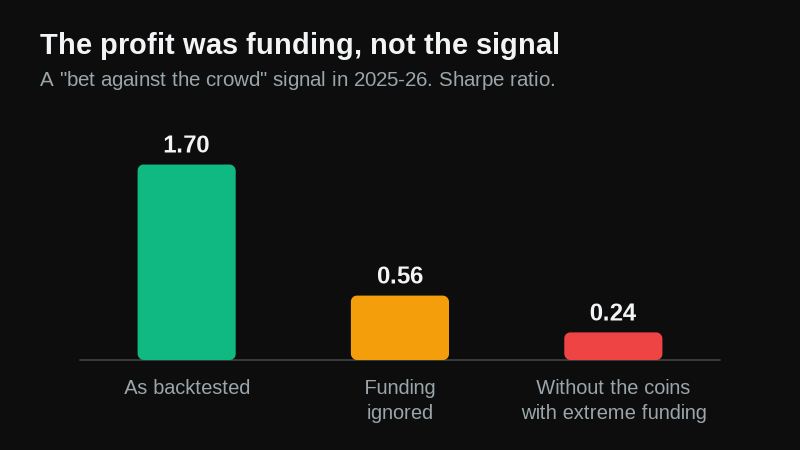
That signal scored a Sharpe of 1.70 in 2025-26. With funding ignored it fell to 0.56, and without the coins with extreme funding to 0.24.
The profit was not the signal. It was funding collected from a handful of tiny coins in a squeeze, some paying around 2% per hour. We rejected it.
Funding cuts the other way too:
- Simply holding BTC, ETH, BNB and gold through futures paid about 5 percentage points a year in funding. Sharpe 0.60 with funding, 0.88 without.
- Our own Vote+ bot depends on funding income. Without it, its 2025-26 Sharpe drops from about 2.1 to about 1.0. We say so, because it is a real risk.
A four-step check for your own idea
Take a strategy you like and do this on paper:
- Write down the average gain per trade before costs, in bp.
- Subtract 12 bp for market orders in and out.
- Double the cost and look again. A robust idea bends, a fragile one breaks. (Vote+ went from 2.41 to 2.32 with costs doubled.)
- Add funding for the time you hold.
A worked example: your setup makes 8 bp per trade before costs. After step 2 it makes -4 bp. Fifty trades later you are down 2%, with an idea that "worked" before costs.
If step 2 is already negative, no indicator setting will save it.
This article is for education. It is not financial advice.
- fees
- funding
- scalping
- costs
For education only. Backtests and paper results do not predict future results. Not financial advice.